Despite several cuts in the Federal Reserve’s benchmark rate beginning at the end of 2024, CD interest rates remain relatively stable during the month of April 2026. The top rates are above 4.25% APY, which is a much higher rate than most banks offer for traditional savings accounts. Therefore, if your savings account at a bank is not earning any interest, this article gives you information about where to find the best CD rates to be able to find a CD that meets your needs.
Quick Answer: What Are the Best CD Rates Right Now?
Currently, the highest rate for CDs (as of April 2026) is 4.25% APY. The highest rates on CDs are now available for short-term maturities of three months to one year. At this time, the average yield for a one-year CD across all FDIC-insured institutions is between 1.90% (as of April 2026), so it is extremely important for you to shop around to find the best interest rate for your new CD and avoid simply accepting a rate that your current bank is offering.
Table of Contents
Best CD Rates in April 2026
All institutions listed below are FDIC-insured or NCUA-insured. Rates are sourced from publicly available data as of April 3–4, 2026.
| Bank / Institution | CD Term | APY | Min. Deposit | FDIC Insured |
|---|---|---|---|---|
| OMB Bank | 5-month | 4.25% | $500 | Yes |
| Newtek Bank | 9-month | 4.20% | $2,500 | Yes |
| Bread Savings | 9-month | 4.15% | $1,500 | Yes |
| LendingClub Bank | 8-month | 4.15% | $2,500 | Yes |
| Capital One | 11-month | 4.10% | $0 | Yes |
| E*TRADE Bank | 12-month | 4.10% | $1,000 | Yes |
| Marcus by Goldman Sachs | 12-month | 4.00% | $500 | Yes |
Rates as of April 3–4, 2026. Subject to change. Always verify directly with the institution before opening an account.
Why CD Rates Are Falling And Why Now Is the Time to Lock In
CD Rates Drop, Make Your Move Now Because You’ll Get Above the Current Market Rate For All 12 Months
By lowering their benchmark interest rate by a total of three times this year, to a level of 3.50%-3.75% in January 2026, the Federal Reserve has resulted in dramatic interest rate decreases on Certificates of Deposit (CDs). In fact, CD rates were above 5.50% in June 2024 and have recently declined to around 4.00% – 4.25%. and should decline further sometime in 2025.
The primary benefit of a CD is that your interest rate is guaranteed for the entire term. For example, if you opened a High-Interest Savings Account (HISA) today at 4.00% interest rate, it could decline in mid-2025 to 3.25% or lower because of actions taken by the Federal Reserve.
Rate-Lock Benefit:
The primary advantage of taking advantage of a CD today is that the interest rate you get today, i.e., 4.10% for a 12-month CD, will remain at 4.10% for all 12 months of the CD, even if market rates are much lower than 4.10%. So you need a lot of interest rate certainty in this environment of declining interest rates.
How to Choose the Right CD
There are four main factors to consider when selecting a certificate of deposit (CD):
- Term Length: You should choose a term length that matches when you will need the funds. For near-term goals (3-12 months), short-term CDs will be most beneficial; for long-term CDs, choose terms that will not be touched for years.
- APY over interest rate: The annual percentage yield (APY) is a better representation of the total interest you will earn than simply looking at the interest rate; you must always compare both CDs’ APYs, rather than simply comparing CDs’ stated rates for this purpose.
- Minimum Deposit: Some financial institutions offer CDs with no minimum deposit, while others have minimum deposits that can be as much as $2,500. It is important to check the institution’s requirements before applying for the CD.
- Early Withdrawal Penalty: Many banks impose an early withdrawal penalty, which typically ranges from 90 to 180 days of interest if the CD is accessed prior to maturity. If you anticipate needing to access the funds before your maturity date, you may want to consider a “no penalty” CD from a bank such as Ally Bank or Goldman Sachs Bank.
CDs vs. High-Yield Savings vs. Treasury Bills
CDs are not the only safe option for growing your savings. Here is how they stack up against the two most popular alternatives.
| U.S. government-backed | CD | High-Yield Savings (HYSA) | Treasury Bill (T-Bill) |
|---|---|---|---|
| Rate type | Fixed for full term | Variable: changes anytime | Fixed at purchase |
| Top rate (April 2026) | Up to 4.25% APY | Up to ~4.00% APY | ~4.17–4.33% yield |
| Liquidity | Low: locked until maturity | High: withdraw anytime | Moderate: can sell early |
| State income tax | Yes | Yes | Exempt |
| Federal insurance | FDIC/NCUA up to $250K | FDIC/NCUA up to $250K | U.S. government backed |
| Best for | Goals with a set timeline | Emergency funds | High-tax state residents |
If you can leave your money alone for a while, a CD will get you the most guaranteed interest rate. If you need access to your money or want to set aside money in case of an emergency, then an HYSA would be a better choice.
People who reside in states with high income taxes should consider purchasing T-bills because the interest earned on T-bills is exempt from state and local taxes, and that should help increase their net return on T-bills.
Key Takeaways:
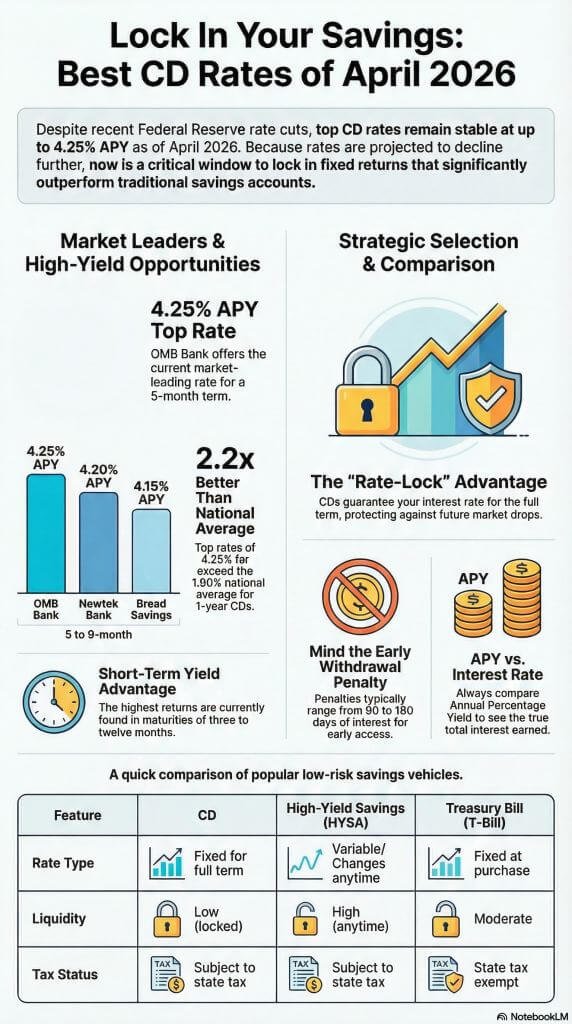
- As of April 2026, a top CD offered at OMB Bank pays 4.25% APY over a five-month term.
- In contrast, the national average rate for a one-year CD is approximately 1.9%. To get the best rate possible, you should shop around with multiple financial institutions.
- Currently, short-term CDs with maturities of three to twelve months are paying the highest yields.
- Online banks typically provide much higher APYs than traditional banks.
- FDIC insurance covers all top-rated CDs in this guide.
- Because CD rates are decreasing, obtaining a CD today locks in your APY and protects against future rate decreases.
Also, read this: Guide to Check Your Credit Score
Frequently Asked Questions
What is a good CD rate right now?
In April of 2026, a good CD rate is anything higher than 4.00% APY. The national average for a 1-year CD is only 1.90% (FDIC, April 2026), so any FDIC-insured rate that is well above this, especially from an online bank, is a great deal.
Are CD rates going up or down in 2026?
CD rates are trending down. The Fed cut rates three times in 2025, and so have banks. Unless the Fed changes course, CD yields will continue to move lower through 2026. By opening a CD today, you lock in a higher rate before this happens.
Can I lose money in a CD?
Almost never. CDs are FDIC or NCUA-insured up to $250,000, meaning your principal will be protected. The only way you could lose money is if the amount of the early withdrawal penalty is greater than the amount of interest earned. This is very rare, but it can happen on severely short-term holdings.
What happens when a CD matures?
Most banks allow a 7-10 day grace period for you to withdraw, reinvest, or transfer funds. If no action is taken, your CD will automatically renew at the current bank rate, which could be lower than your previous one. Setting a reminder on your calendar for your maturity date could be helpful.
How much interest can I earn with a CD?
A $10,000 CD with an Annual Percentage Yield of 4.10% will yield around $410 in interest over a 1-year term. The same CD at $50,000 with the same APY will yield approximately $2,050. Use a CD Calculator to compute the exact amount you will make from your CD based on the amount of your deposit and the term (number of years) you select.
Editorial Disclosure: This content is for informational purposes only and does not constitute financial advice. CD rates change frequently. Always verify current rates and terms directly with the institution before opening an account. FDIC and NCUA insurance limits apply. Last updated: April 4, 2026.